


-
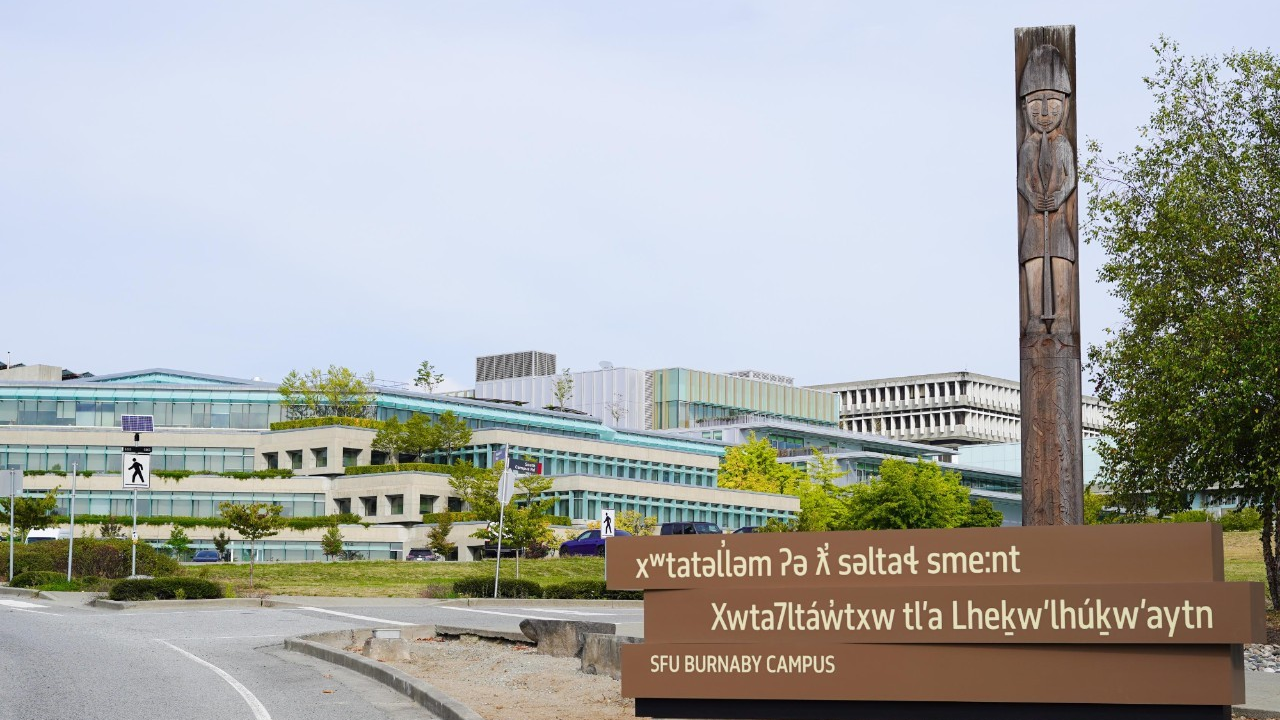
New Indigenous names honour culture, language and place at SFU
Indigenous names have been bestowed upon Burnaby campus, the First Peoples' Gathering House, the Indigenous Student Centre and other key locations at SFU. learn more →
-
Term Info: Fall 2026
Add courses, view office hours, future offerings, and more. learn more →
-

Celebrating 60 years of linguistics at Simon Fraser University
Laurel Weldon: “The exciting new collaborations with other departments, universities and communities around the province and across the world lead me to expect another 60 years and beyond of even greater success.” learn more →
Hear from our students
“What I love about linguistics is that language is such a human thing. And what linguistics does is instead of enforcing or prescribing rules for how people should speak, it describes and seeks to understand how languages evolve and develop and how they work.” –Student of LING 220: Introduction to Linguistics
“My favourite part of this class is developing language games and gaining real-world experience with kids visiting Science World. The course truly brings linguistics to life and you get to see what the science of language is about first hand.” –Student of LING 350: First Language Acquisition
Undergraduate programs
- Linguistics Honours
- Linguistics Major
- Linguistics Extended Minor
- Indigenous Languages Minor
- Certificate in the Linguistics of Speech Science
- SFU–Canterbury Pathway to Master of Speech-Language Pathology
- Computing Science and Linguistics Joint Major
- Social Data Analytics Minor
- Certificate in Indigenous Language Proficiency
- Diploma in Indigenous Language Proficiency
- Linguistics and Anthropology Joint Major
- Indigenous Studies and Linguistics Joint Major
- Concurrent BA–MA in Linguistics
- Linguistics Discipline - Cognitive Science Major
- Linguistics Discipline - Cognitive Science Minor
- SFU–Exeter Accelerated Law program
- Medical Humanities and Social Sciences Minor
News and events
-
September 22, 2026
New Indigenous names honour culture, language and place at SFU
Indigenous names have been bestowed upon Burnaby campus, the First Peoples' Gathering House, the Indigenous Student Centre and other key locations at SFU. -
September 13, 2026
Science of Speech - seats still available!
Register today! Email sara_ng@sfu.ca -
September 10, 2026
SSHRC fellow Kaili Vesik joins the Phonological Processing Lab
Congratulations to Kaili Vesik for being awarded a two-year SSHRC postdoctoral fellowship. Her project is titled Leveraging computational models to predict challenges and successes in human second language acquisition. -
September 08, 2026
Welcoming the 2026 cohort of Linguistics grad students
We'd like to introduce Favour Chibueze, Vic Lancaster, Marcell Maitinsky and Alice Munro, and to welcome back Ben Chung, Ellie Dueck and Gento Okawa. -
August 31, 2026
Celebrating 60 years of linguistics at Simon Fraser University
Laurel Weldon: “The exciting new collaborations with other departments, universities and communities around the province and across the world lead me to expect another 60 years and beyond of even greater success.” -
August 18, 2026
PhD Thesis Defence: Yifang Yuan
Yifang’s thesis is titled “Asking questions in context: Evidence, social relations and question-form choice in Mandarin Chinese conversation.” -
August 06, 2026
Boey Kwan earns First Class with Distinction and begins career in fintech
“In my everyday life, I constantly feel excited to expand my horizons and challenge the way that I approach puzzles and problems, so that I don't become complacent or stagnant.”